
Get back to the word
Derrick Austin on photography, ekphrastic poetry, This Elegance

When I’m reading, one of my favorite experiences is when the work makes me want to write. This is something I became more aware of when I was taking classes with Rebecca Lee, who would say this as a compliment of the work. Reading Derrick Austin’s third collection of poetry, This Elegance, and speaking with him about the book’s artistic interests and formal play, made me similarly want to clear my calendar, watch a great movie, and find my way back onto the page.
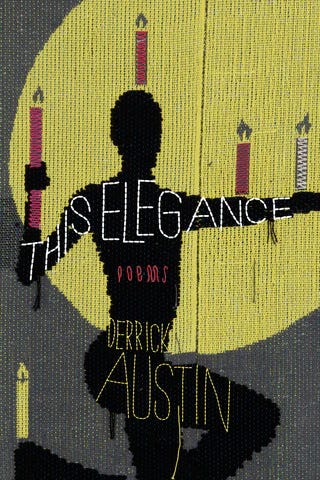
Moving from the halls of Madrid’s Prado Museum to drag shows at gay bars and the pages of the speaker’s diary, This Elegance is a collection that’s full of life. With attention to dreams, tarot, and the places the places the mind travels, these poems contemplate divinity, eroticism, and a life lived through art across time.
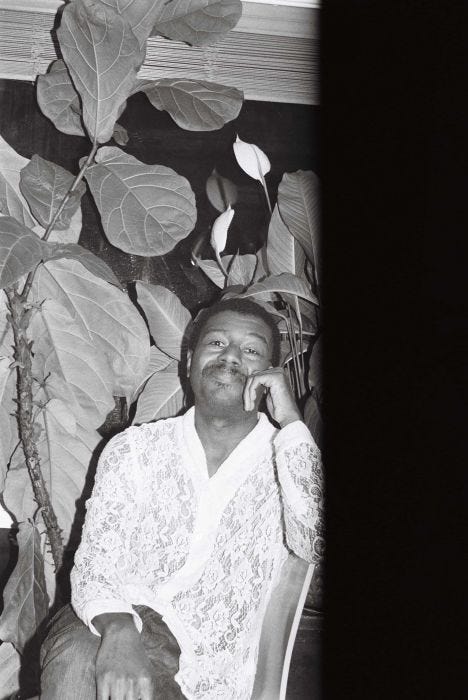
A Chicago-based poet and Cave Canem fellow, Austin is the author of Trouble the Water and Tenderness. We caught up earlier this week to talk about This Elegance, mysticism, and different forms of artistic intimacy.
I’m so excited to talk to you about This Elegance. Your third book is out this month. How has this book’s release felt different from your previous works?
I feel like I am more aware of how long I’ve been doing this. It’s been 10 years since my first book, which is a strange sentence to say, but I think that I’m much more comfortable and relaxed this time around. When the first book comes out, it’s this big thing that you’ve been working up to, and there’s a whole lot of anxiety around that and a lot of emotional import. My second book came out the summer after the pandemic, so everything was upside down. This time has felt so much more comfortable and relaxed, and it’s gotten such a lovely response. I’m very thankful.
Ekphrasis feels like a core process in this collection. Can you get us inside of your artistic process? How does consuming and reacting to different media inspire you to write?
Ekphrasis has always been a big part of my poetics. A big part of ekphrasis for me is the ability to think about multiple things at once through one subject. If you’re writing about a painting, there are so many different ways you can access it. You can think about it as a historical object, you can think about it as a cultural object, as an aesthetic object. There are so many different ways to engage with it that I find positively thrilling. It makes me feel more connected to the wider world.
It’s a way of moving beyond yourself, which I find important as a writer too, to escape myself and my concerns, or at least to see how my concerns and my interests overlap with something else, and see the interconnectedness of it all. That delicious entanglement is part of what’s so fun and generative about ekphrasis for me.
I’d love to hear more about that process of getting entangled in something. Can you reach back into the creation of one of these poems?
Yeah, it’s really interesting when I write about visual art. A lot of the ekphrastic poetry that I’ve written has come out of moments of surprise and being unexpectedly pulled in by something. There’s a poem in This Elegance called “Madrid.” I went to the Prado, and I remember seeing this enormous painting, “The Calling of Saint Matthew,” by Juan de Pareja. It’s a painting that I had known of but had never seen in person before. It’s enormous, and the part of it that moved me the most is that Juan de Pareja, who was a painter of African descent, inserted himself into the painting. There’s this larger-than-life-sized self-portrait of this man in it, and I was so taken by his gaze. As soon as that moment happened, I knew that would enter into a poem somehow. That moment of surprise is the thing I’m always chasing as a writer.
It’s a way of moving beyond yourself, which I find important as a writer too, to escape myself and my concerns, or at least to see how my concerns and my interests overlap with something else
Within that, too, I found that the collection is asserting that a variety of forms are worthy of poetry—from Vespertine to drag queens. Did you feel a particular imperative in what you wanted your work to respond to in these poems?
I’ve been fortunate to have had teachers in my past dissolve that artificial boundary between highbrow and lowbrow. I remember being a student and hearing older conversations about whether pop culture should be in poems. One of my mentors in undergrad is an incredible poet named Erica Dawson, who has always written about pop culture as well as fine art. From the jump, I’ve been engaged with that.
Part of being a writer is writing what you know and what interests you. I’ve been to my share of gay bars and seen plenty of drag queens, and I’m always watching movies if I’m not reading a book, so movies are always going to crop up in the poems. It’s not even a thing that I consciously try to do. It’s just as much a part of my life as writing about my friends or the landscape that I live in.
Definitely. That made the work feel so alive to me. Photographic documentation also becomes an important theme in the collection, which contrasts with a “diary’s rigorous privacy.” Can you speak to that contrast? Does one lead to a different kind of truth?
Oh, that’s an incredible question. The camera entered the manuscripts mostly because at the time that I was writing these poems, a lot of my friends were interested in photography and would talk to me about what they were up to. Photography entered into my language and consciousness in a really immediate way. I thought that would be an interesting counterpoint to the poems about painting, thinking about differences between the immediacy of a photograph as compared to the work of a painting.
The diary poems to me are another kind of immediacy. Something about the form that really drew me to it was the formal formlessness of it. If you’re writing in a diary, you’re ostensibly writing for yourself, and so a diary can contain any multitude of things. I love the way that a diary can plunge you so deeply into a life but without context, so you’ll just have these flashes in the same way that you won’t have the context necessarily behind a photograph. They speak to each other’s intimacies, more casual and unguarded intimacies.
And it all passes through the medium of poetry in the book, too.
Poems to me feel so profoundly intimate, and yet my poems are not often purely autobiographical. I’ve never really been interested in recording the facts of my life in that capacity, yet I find poetry to be even more vulnerable than a blanket kind of confession might be. Emily Dickinson was one of my first poetry loves. You could read those poems and not really learn much about the specifics of her life, and yet they’re so hair-raisingly internal and intimate and revealing. That’s what I was interested in—creating a space for intimacy to exist between the writer and the reader.
Tarot and mysticism thread throughout the entire book—I loved “Miracle Play” so much. What intrigues you about these traditions, and how does your artistic practice perhaps draw from them?
I’ve always been interested in religion and spirituality. I loved my history classes when I was a kid. I loved learning about different cultures and particularly the ways that people worshiped and prayed. I didn’t grow up going to church. I’ve never had a divide between an interest in conventional religion and also these mystical traditions like tarot reading or astrology. I’ve always found questions on the relationship between the self and the divine, or the self and God, to be worthwhile questions to pursue. Whatever your orientation to belief is, art that engages in questions of faith and belief are topics that we all think about and have an investment in. I wanted to engage in this tradition because of that.
Also as a queer writer, writing about Christianity felt urgent for me when I was a younger poet coming out of the second Bush administration. A lot of my favorite writers have also been engaged in this tradition too. I’m one of the few strange people who loves John Milton.
I have to confess, I’ve never read any Milton.
He eventually lost his sight. One of my favorite sonnets in the world is by him. It begins with, “When I consider how my light is spent.” A thing that I love about it is you can tell exactly where the volta is because the sentence structure changes. It’s heavily enjambed and then suddenly becomes end-stopped in a really compelling and emotional way.
What are you interested in exploring in your own poetry right now? Are there new dimensions to this interplay of media and form that we’re talking about that are intriguing you?
Absolutely. I’m working on this hybrid project about ekphrasis and visual art. I have these things I’ve been calling prose poems, for lack of a better word, that are poems slash art criticism slash art writing. I’m interested in the boundaries of that and how that can exist within the context of prose, including prose poems. I’m in an experimental and generative space right now. If it’s something I haven’t tried before, I run headlong to it.
Order This Elegance and read more of Austin’s work here.
Lightning round
Favorite books right now?
I have a galley of a friend’s essay collection—I Have This Thing for Flowers by Alysia Li Ying Sawchyn. It’s an essay collection about her life through the mode of flowers. That’s been really beautiful to read.
I’ve been reading Plainwater by Anne Carson and thinking about hybrid forms.
A book I read a few months ago but is still on my mind is Jazz by Toni Morrison. I hadn’t read it before, and it was just a thrill. It’s such a fun and messy novel in a really compelling way, while also being in that Morrisonian way profoundly rich and engaging about the complexity of Black life. That book is incredible. Read Jazz if you haven’t read Jazz.
Current obsessions?
My obsessions are sort of the same as they always are: paintings, movies. I live in Chicago and have a membership at the Art Institute, so I’m always down there looking at paintings.
Chicago is such a great movie town. I’ve been watching a lot of Joan Crawford movies and Akira Kurosawa. I watched Seven Samurai and Throne of Blood last week, which are incredible. Throne of Blood really is one of the best Shakespeare adaptations ever, and Toshiro Mifune is such a hot actor. It’s always great looking at him on the screen.
Best new movie?
I still need to see Mother Mary. I’ve been following news about Cannes. There’s an adaptation of Mrs. Dalloway with an all-Black cast that’s set in West Africa, and I’m excited to see that. I’ve heard the first reviews of it are really positive. That’s exactly what I need in my life right now.
Best writing advice that you’ve received?
It’s not reinventing the wheel, but just reading widely and deeply. I’ve been thinking about that a lot lately, in terms of where I’m at creatively and trying to sink my teeth back into books in a real, concerted way. If you’re a fiction writer, read poetry and fiction and read comic books and magazines and science texts—whatever texts enrich your life. It’s important to refill the well and get back to the page, and get back to the word.
Reference Section
Read more on ekphrastic poetry from Joshua Garcia.
Note: I earn a small commission when you shop using my links, which helps support Referential’s free subscriptions.