
Goodbye, Portland
What does it mean to be from somewhere? What does it mean to leave it?

When I moved away from Portland in 2019 for my MFA in North Carolina, I wrote an essay about what it meant to me to build a home only to leave it. Moving again, I revisited this essay and wanted to share it. It’s somewhat of a time capsule—I shared it with my writing group and they could see that it came from a version of me they remembered from our first workshops—and still I feel these same feelings resurfacing: what does it mean to be from somewhere? What does it mean to be leaving again?
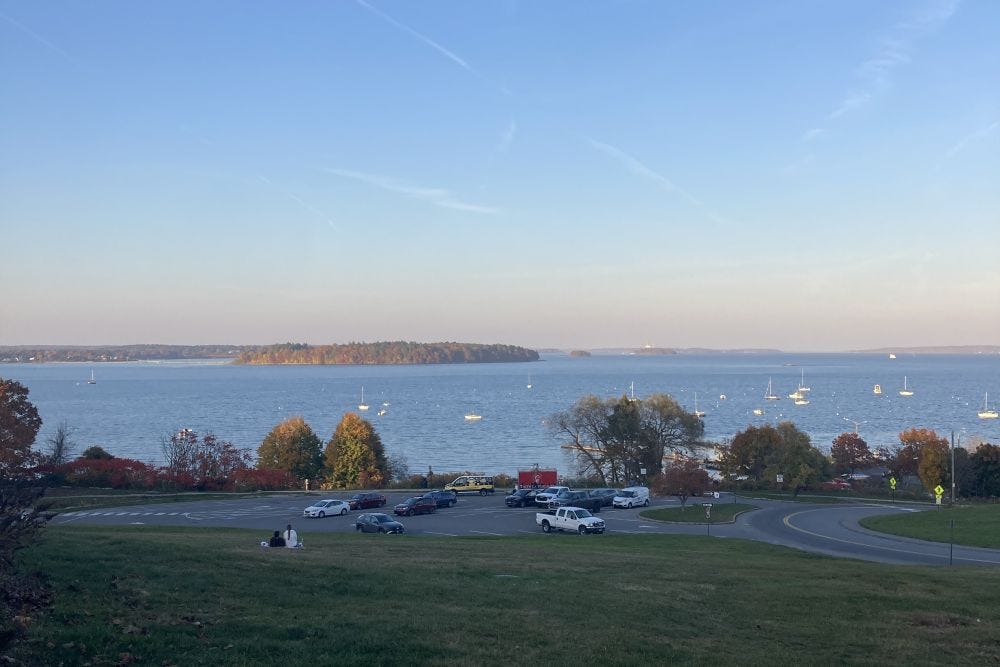
Our city is known everywhere for its food. In a food writing class, I wrote of the nights spent cooking dinner at home, Portland’s endless restaurants exceeding our entry-level budgets. Within a year of my move, Portland was named Bon Appetit’s “Restaurant City of the Year,” but I missed out on the bulk of them. I studied harvest break in Aroostook County and drove with a friend north to Houlton. We stopped at Dysart’s en route and ate chicken pot pie. The famous couple from the restaurant’s commercial ate buttery flaky crust by the window. In Houlton, we ate ice cream at the dairy bar and swam in the hotel pool at night. We drove through sunflower fields and rolling hills, admiring our new state. We’re transplants, lingering since college, and we never want to leave. And since college, we’ve learned how much more we want to learn about this place. Though Portland is where we live, we want all of Maine to be our home.
One of my high school history teachers spoke of the urban tribe, groups of young people who prize friendship and migrate around the country together. Think Friends, he said.
We are young professionals. At work they called us YoPros. We’d cook dinner for each other and eat our leftovers the next day for lunch. We’d lose at trivia night. We’d go to the beach for a picnic on Wednesday night. We tried to hike.
We’d roll our eyes at weekend visitors from New York who strutted down Washington Ave and crowded the cocktails bars downtown. We’d scoff at the luxury condos and dreamy homes with private swimming pools. We’d wonder who was building them—older developers from the state—and we’d wonder who lived there—retirees, people with money earned in other states. We’d walk by our old place, where the rent rose with its luxury neighbors, where someone spray-painted on the fence outside another construction site, “Build shelters not condos.”
We’d go home to apartments with our two or three other roommates inside the homes of people we do not know, the owners of which live in Falmouth, in the suburbs of Boston. Apartments across the street, next door are Airbnbs. Their guests wait for Lyfts on the curb early Saturday mornings, playing music on cell phone speakers.


Karen is my roommate’s mom, a Mainer, except not really because she grew up everywhere but Maine. My roommate and I lived with her between leases, my roommate in her room and I in the basement apartment. In the mornings, I’d write at the basement bar. Sometimes somebody would come down to use the washing machine and find me there.
Karen hosted fish taco night. Each time there would be a new cocktail, new guests. We’d say she should open a taco truck on the Eastern Prom. We’d say she makes the best tacos in Maine. When I order fish tacos elsewhere, all I want are hers. When I think of home, I think slices of avocado, lime wedges, pickled onions on tiny red plates.
Fish Taco Night is tradition.
It’s tradition to go to power yoga on Sunday afternoon and get cake at Tandem after.
It’s tradition to have roomie dinner Monday night. To go skiing and get Dunkin’ discount lattes on the way home. To have fish taco night at Karen’s and mix cocktails and eat all-dressed chips on her porch in the summer.
If we have traditions and habits and memories and memories, maybe we could say this city is also one for us.
We aren’t from here, except the few who are. But we aren’t quite from away if we’re not like those obvious New Yorkers, those cruise-hoppers, right? We worked for Maine organizations. We lived in a city others were designing in pop-up knick-knack shops and jewel-toned cafes, so it was different, right? We got to watch the owners of these shops come and go, replacing each other’s shops with new knick-knacks and succulents and telling us what we must want over and over again.
Right? Right?
In his essay “Welcome to Portlyn,” Ron Currie considers gentrification, the yuppie, people who have settled in the city, uprooted those already here, and firmly planted a flag to designate Portland a city for those From Away. Though the only connection I find today to Massachusetts is the way I drive, I was born there. I am from away.
In college in Maine, people spoke of connection to place, sharing big ideas about getting to know this great state, appreciating all it has to offer, and listening to the people that we meet here. On weekends, students went on backpacking and canoeing trips. They drank volcano bowls at the sushi restaurant and got drunk at the dive bar on Maine Street.
If we have traditions and habits and memories and memories, maybe we could say this city is also one for us.
But it’s easy to see only those things, to look at a college town and only see the transience and miss the connection that the students hunger for. In college, I made a friend in my meditation class, Ruth, an octogenarian who goes to acupuncture and eats vegan. She’d take me for Vietnamese and I introduced her to Little Dog Café, where in later years she suggests we meet. With friends, I journeyed to Giant’s Stairs for the sunrise, Milbridge to learn about community work and migrant blueberry picking. And after college, it was the Fryeburg Fair or a road trip to Skowhegan or floating down the Presumpscot River on summer’s hottest afternoons, when beaches are too crowded and ocean water numbs fingertips and toes.


In North Carolina, I live among strip malls, fast food restaurants, gun shops. People in my graduate program ask where I am from. At first I say Maine, but then I double back, sheepish. Well, originally Massachusetts, but it’s been a while, but I haven’t been back, but I go there now and feel nothing. I don’t even bump into old classmates anymore. Everyone I once knew has gone.
I wonder what it will take to claim Maine as home. Mainer friends say it’ll never happen, I’ll never be able to claim Maine as my state. Or they tell me to stop saying I’m from away, it’s insidious, it’s not funny. It depends on the person. For me to make Maine home, I should not want to be from there. I should realize that I am From Away. The best way to become part of this state is to accept that I am not a Mainer. I’m not from here but live here now.
I’m from an endless slew of suburbs in Massachusetts. Once my parents left our town, my roots came up so easily they crumbled. I see what I once called home in the multiplying strip malls of Cook’s Corner and Maine Mall. I see it on the roads of North Carolina, where I now live, but here there are Chick Fil-As, which by now my hometown has too.
As I detached from what was once my hometown, I began feeling that Maine had already assumed the role of adoptive state for me. In Brunswick, a palimpsest of memory unfolds before me. There’s the park bench where we got ice cream and then I ate tacos with my work friends years later. There’s the spot in the Commons where we had our heart-to-heart and I made decisions about life after college. Before leaving Portland, I would unpeel layers of memory from everywhere I went. Leaving, I inhabit each layer at once.
While I feel onion-like, ogre-like, Currie writes, “I feel the dark allure of a staunch tribalist attitude, and I find myself wanting to slap a ‘Please go home’ bumper sticker on my car. Because I am wary, with reason, of what happens when those visitors decide that they are home.”
So maybe Maine’s From Away distinction means that beyond the bounds of my college campus, I should not have gotten to know this state. I should’ve gone back to a home that I no longer know, that I’m not sure how to resurrect, or why I would. I hear politicians say that we need to drop From Away, that we need to let Maine grow and change and flourish. How can you ever be at home in a place when you won’t ever be able to say you are from there as your years there accumulate? How can the state adapt and find a future as it shrinks upon itself? How can it welcome anybody who hasn’t been from Maine since the 1800s?
In his essay “Parallax,” André Aciman writes of exile, of how returning somewhere, to old homes, is also an act of remembering what it was like to think of being elsewhere while there. He grew up on the shores of Alexandria, Egypt and was displaced to Europe and then the U.S. He cannot return to Egypt without remembering living there as a child longing for Europe, for getting out. He cannot be in New York without seeing glimpses of Egypt and longing for an Egypt that is no longer there.
He speaks of rehearsing sadness, of preempting emotion:
I would peek out the window and look at the spot across the street, where I was in the morning rehearsing what I’d be doing that very afternoon, except that the rehearsal was incomplete unless I could anticipate thinking back on that morning’s rehearsal. I was trying to be in both places at one and the same time.
Before leaving Maine, I’d go on cathartic drives to Mackworth Island. I’d cross the bridge to Falmouth, blasting music that staged my dress rehearsal, that exorcised the emotion preemptively. I was leaving as I should. It is better to expunge the emotion when it does not matter, before it becomes real. It is better to rehearse the sadness, because why mourn a place where I am only a temporary resident, where I may put in the effort to love and to know it but will have to leave again?
Now, I drive everywhere. I exist inside of cars with AC anaesthetizing my core. I move from one air-conditioned capsule to the next. Now I drive to the movies alone. When the film ends, the hallways are empty, unfolding, sinister. I itch to walk, to debrief the film with my friends, to breathe the air off Casco Bay after hours inside air conditioning. I have left Maine and feel it everywhere. I do not claim it as home though it is the place I long to claim more than anywhere.


August is peak moving season, a representative from U-Haul told me on the phone. My friends moved to their next apartment in the city weeks before I left for North Carolina. After the housewarming, we all went to Bubba’s. A collection of college friends and work friends and significant others and friends’ roommates who we’ve stayed friends with crammed into Ubers. I realized it would be my last time at this club for a while.
“I wonder if there’s anywhere like here in Wilmington,” someone said. They called no jumping on the dance floor before playing “Come on Eileen.” When the club closed, we stood in the parking lot, waiting to go home.
I’m the first to leave, to disband, to go away.
I’ll come back to the city, and someone else will be my roomie’s roommate. Our traditions, our favorite places will change or stay the same, and there will be new places in this city and the ones we’ve known may close.
I will cross the Piscataqua Bridge and feel the driving get easy.
I will pass the Kennebunk rest area and know there’s no need to stop now.
I will feel the surge in 95, when the road dips and erupts again and know I am in Scarborough.
I will know it by Casco Bay Bridge extending to the right and Call Joe in the sky.
Our city lies ahead. I am almost there.
—Wilmington, North Carolina, 2019
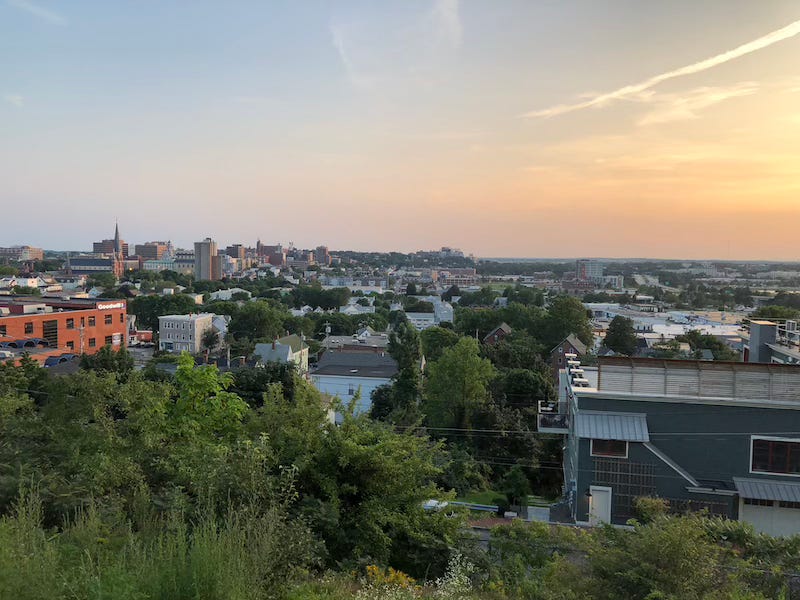
I’m moving again, this time to New York. Since June, I’ve been living in both Portland and Brooklyn, transiting between the two every two weeks. A week before Christmas, I stopped in Yonkers on a special errand: I wanted to get crumb buns for my mom at the Italian bakery we used to visit Sunday morning before going to church.
I’d only been back once since my grandmother left New York 10 years earlier. Delite closed briefly in 2024 after a fire, but when I stepped inside at 6am, it felt the same as ever: black and white cookies, sfogliatelle, cakes colorful as jewels beneath the glass case. I could smell the powdered sugar in the air. My grandfather—a quiet Neapolitan—would get my mom their seven-layer cake for her birthday.
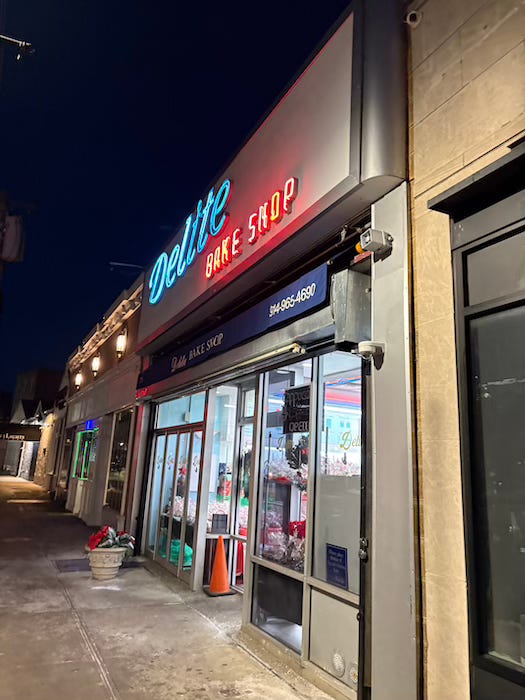
I cleared out their stock—they had a baker’s dozen—and hopped back on the Sawmill Parkway, passing the exit for my grandparents’ town. The light was deep and low and made me think of how we used to drive this same road back to Massachusetts on Christmas Eve night.
My great grandparents found their way to the Bronx from southern Italy. After my mother was born, my grandparents left the city and moved north. Every three weeks, I’d sandwich between my sisters in the back of the Ford Taurus wagon to visit my grandparents and we’d complete a familiar routine: cold cuts for lunch on Saturday, a visit to my great aunt and uncle in Yonkers, church, but not without a visit to Delite first—if I was up early enough, I’d join my dad for the ride.
When I watched The Sopranos, I felt the show scratching at something familiar but tilted just a bit differently: the New Jersey rendition of morning coffee, gabagool, gravy, Sunday “dinner” at noon. Part of why I loved the show so much is that it made me feel more connected to what was lost when we stopped making those frequent visits, and then again when my grandparents’ generation passed away.
Even though she’s lived in New England more than half of her life, my mom will always be a New Yorker. Leaving the bakery, I could feel the pull back to parts of my life that have been dormant for a decade. If I go looking for signs in the city, the closest I might come is the cemetery in the Bronx where my grandparents are buried and everyone seems to be Italian. But still, living here, a place where they were from, I can’t help but feel that I’m looking.
Reference Section
For those unfamiliar: buttery flaky crust:
Micro-screed: I’ve been thinking a lot about Heated Rivalry since it seemingly took over TV, the internet, and other people’s social media feeds. Are people loving it in the same way as The Summer I Turned Pretty? Do we all know it’s bad? I also heard someone comparing it favorably to Looking, which I really resisted. Heated Rivalry shows gay men being hot, closeted, and tortured and making bad choices because of that set of circumstances, whereas Looking shows gay men making bad choices because they’re selfish humans. Both shows are sometimes shot and written as the preamble to a porno, yet Heated Rivalry ascended to the mainstream while Looking was kind of boring. It all makes me feel that Heated Rivalry is for people who want to see inside gay life for hot, tortured men who are secretly sensitive and have repressed masculinity and are also famous and professional athletes, as opposed to Groff who’s a level designer at a game company, problematic, basic, tough and deeply satisfying to watch.
We will miss you and can’t wait to see and read what you do next. You’ll always have a home at PPY!