
I felt this freedom and loss that this book isn't going to happen
Inside Story with Taryn Bowe: Camp Emeline, artistic careers, Edie Falco

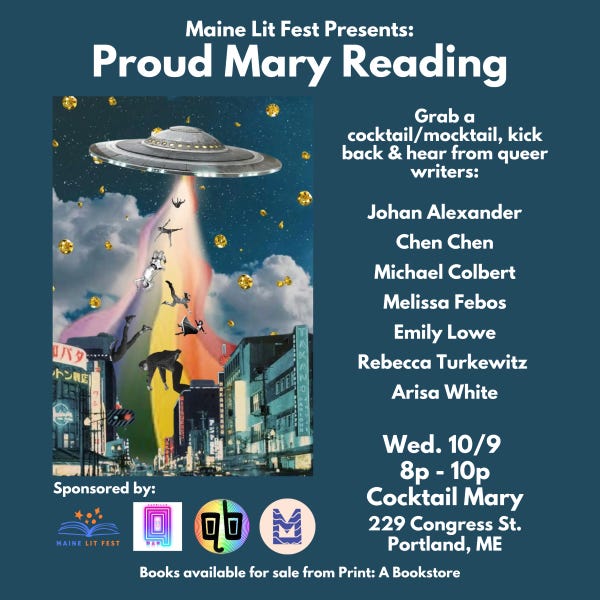
Taryn Bowe is a superstar of the Maine literary community. She’s the associate director of the Maine Writers and Publishers Alliance (MWPA). I’m currently an MWPA Lit Fest Fellow and have gotten to know Taryn through our work together there (check it out in the Portland Press Herald!). The schedule is bringing some incredible writers to Maine, and you should definitely check it out if you’re local, or Zoom in to select events.
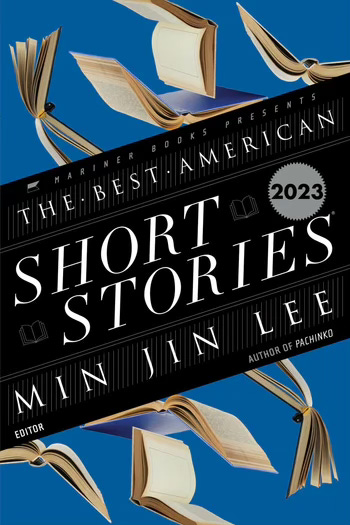
Taryn’s writing appears in The Sewanee Review, Joyland, and Epoch. Her story “Camp Emeline,” was anthologized in The Best American Short Stories 2023 and was read by Edie Falco (!!) on the show Selected Shorts at New York’s Symphony Space.
Ahead of the Lit Fest, we spoke about the story behind the story, cultivating weirdness and writing against the market, and balancing career and personal aspirations in the arts.
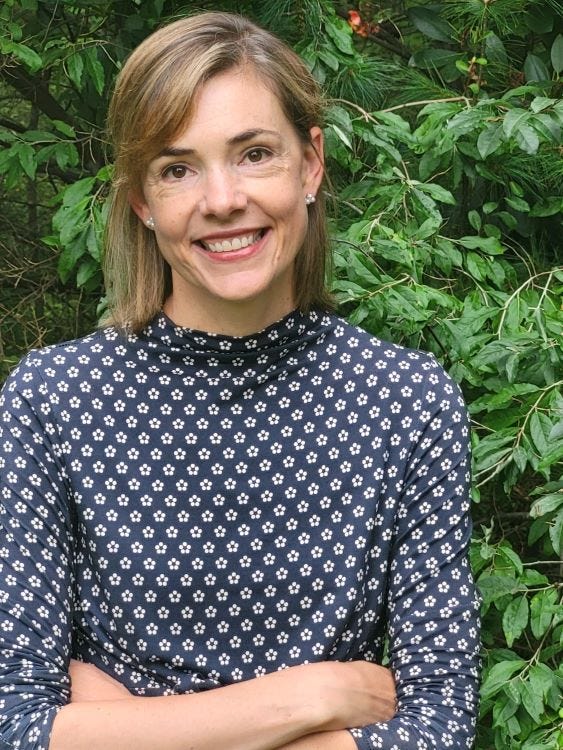
So we obviously met through the Lit Fest, but I wanted to talk about your writing first. “Camp Emeline” has earned wonderful and well-deserved praise. I’d love to talk about the genesis of that story and your process.
About a year after my mother passed away, in a really raw period of my life, I volunteered with a friend to teach some creative writing workshops at a camp for kids who had survived suicide loss. Obviously, we weren't the most popular activity at camp—there was canoeing and paddleboarding and all kinds of stuff. It's called Camp Kita; it's here in Maine, and all the kids go free. I was reeling from a loss, and I think sometimes when you're in that space, all of your pores are just open to other people's losses in a different way than you might be at another point in your life.
I was so amazed by the ways in which these young people, who were carrying around a lot of grief, were connecting, having fun, and making friendships while also being there to process and figure out how to carry these very significant losses in their lives. That also stirred up for me so many of my own memories of overnight camp: being a counselor at one, having gone to one, and all the stories and wacky things that people do at overnight camps that maybe they don't other places because it's this sheltered, protected space.
I felt this freedom and loss that this book isn't going to happen, but now I can do whatever the fuck I want. I'm not trying to write for a marketplace; I'm just going to write a weird story for myself.
Every week, the camp shifted its demographic. The week that I was there, it was for youth who had suffered suicide loss, and the weeks after were for people who were paraplegics, and then it might be for folks with significant cognitive disabilities. The counselors who did sports and craft activities went for the whole summer. I remember one of the counselors talking about how norovirus spread through the camp one week when the folks who were there were already living with significant physical disabilities. It reminded me of the positive things that can happen in these contained spaces, and also how sometimes things can just get out of control, whether it's a rampant spreading illness, or it's people coming together with lots of emotions and not much sleep and mosquitoes.
That provided the seed for the story. I’d just finished writing a novel that I had sent out and come to the conclusion that it wasn't going to get an agent. I had sent it out to about 45 agents, and got some bites, but nobody wanted to represent it. I was coming to terms with that being done, and asking, “What am I going to do next?” I felt this freedom and loss that this book isn't going to happen, but now I can do whatever the fuck I want. I'm not trying to write for a marketplace; I'm just going to write a weird story for myself.
That was the spirit behind putting those words down on the page: I'm just going to write whatever comes into my mind, and I'm not going to censor it for weirdness or marketability or things I don't want people in my family to read. I shared it with my writing group with a lot of trepidation and anxiety. I think it was a new level of vulnerability. As writers, I feel like we're always pushing ourselves to get deeper. That piece was a new level of revealing my own darkness and weirdness. They were lovely in helping to shepherd it along through many drafts and iterations.
As writers, I feel like we're always pushing ourselves to get deeper. That piece was a new level of revealing my own darkness and weirdness.
It's great to hear your journey with it. The story is rich with such a clear voice. How did you find the narrator?
Even as we age and get less and less in touch with the language of teenagers, I do feel like there's always this internal teenager inside of me that's kind of angsty and full of longing for things, but not necessarily understanding that. I love that narrator so much because she's pissed off at the world, but she's also extremely vulnerable. I think the voice was not a difficult part of the story for me. I think the difficult part was figuring out a way to involve so many characters, have them be developed, and not have that dilute the narrative.
With Libby, the narrator, I think it was because I was writing in a place of mourning my mom, seeing the way my family was splintering apart a little bit because she was really the glue, and wanting to process that, not as a 40-year-old woman but as a teenager because my feelings felt teenage size, not controlled, adult size. That voice is not me, but it was the emotional truth of what I was feeling at the moment.
It's also funny that you talked about working on a novel and saying, “Fuck it, I’m going to write this other thing,” because this story feels as expansive as a novel.
I know. I think sometimes when we're trying to write something expansive, we probably end up writing something really limited because we're trying so hard to make it one thing, but when we're not thinking about it, and say, “I'm going to write a really simple story,” we just get it all out.
You had some major successes come from this story. What was it like watching people interact with this once private thing in these very public spheres?
The Best American Short Stories was always one of my unspeakable dreams. That and a book of my own were the two writing things that I was like, I can die happy if these things happen, but I’m not going to talk about them out loud because they feel too outrageous.
When that happened, I was so excited and grateful and totally flabbergasted. At the same time, I remember two or three months afterwards, I couldn’t sleep well. My heart would be beating really fast and I’d have to listen to classical music or movie background music to try to relax. I think I was feeling that “Oh shit, people are going to read this, and if they read it, they could hate it.” There are so many things they could take away differently from how I intended it. Even just my dad could read it, or people could read it and write something terrible about it that I will probably find and read. I was pretty panicked about it for a while afterwards.
Sometimes, I think when people with illnesses are portrayed in literature or movies, it's so lopsided and focused on the sickness piece. I wanted to create and explore some stories where people are living the full life with all of the little minor dramas too.
At the same time, I was elated. This was different from most of my stories that I send to literary magazines and are read by maybe 30 people. Then things started happening around it, which is so interesting to me. This is the story that’s at the start of my collection, and it has the DNA for every story that comes after, but for some reason I thought this was the weakest one. It was so surprising to me, and really undercut my own way of how I think about and evaluate my own work.
That said, the Edie Falco reading was the highlight of my life. She’s one of my favorite actresses. I think of The Sopranos as high art. It holds up so well over time. I got to meet her and hug her. She was hilarious. She treated me like I had done this before, like this happened to me all the time. She was asking me how many of my pieces had been read on Selected Shorts, and I was like, “Edie, do you even know? This was plucked from obscurity–I am so lucky to be here.”
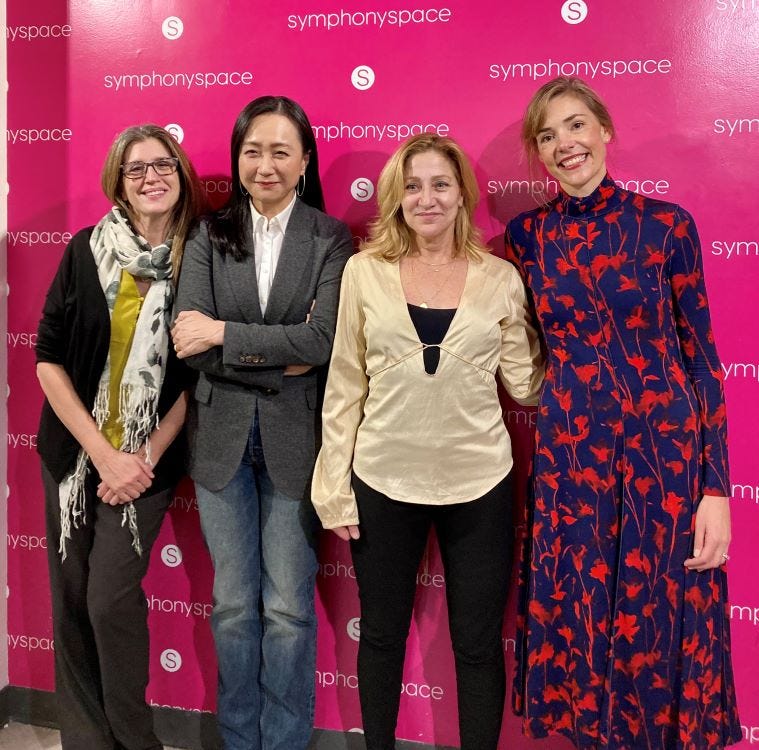
I’d never read it aloud myself in front of an audience, so I didn’t have any sense of how people would respond. I was in the audience with my husband, who had never read the piece. I was nervous. 250 people were there, and I was holding my husband’s hand in a death grip the whole time that Edie was reading. It was so surreal. She’s amazing.
It was so fun hearing people laugh in the recording. It's a funny story, too, through the grief and heaviness.
Thanks for noting the humor. I know sometimes that gets lost in things, but I don't mean to be all darkness all the time.
Can you talk a little bit about your collection and what you're working on now?
I am working on a collection of linked stories that center around this family and the themes of this camp, and what it is like to live with a chronic physical or mental illness.
I wanted to portray that you can be ill, you can be in a hospital, you can be struggling, and you're still going to worry about if this person likes you or not, or a friendship that's gone awry. Sometimes, I think when people with illnesses are portrayed in literature or movies, it's so lopsided and focused on the sickness piece. I wanted to create and explore some stories where people are living the full life with all of the little minor dramas too.
The inner teenager gets to be there. I can’t wait to see it—it sounds great.
I also want to ask about your work at MWPA. Can you share about your role and how you got into this work?
My role is Associate Director. I do a lot of grant writing and a lot of special projects like the Lit Fest or our Community Word program. I help run those programs in collaboration with our Executive Director. It’s a lot of project management, grant writing, and then, since we're such a small shop, we all end up doing a lot of other stuff.
I'd never had a job I liked before this. I'd worked in health policy. It was interesting enough, because I like that health piece, but it didn't mean much to me, so I remember really wanting to break into the arts world in some way. When I saw this job open up, I thought it would allow me to not live such a compartmentalized life where work, family, and creative stuff weren’t connecting.
What’s your favorite part of your work?
I love the team of people that I work with. I love the Lit Fest Fellow program. I think it’s so cool to support other people to bring their ideas to fruition around literary events and activities. You have a finite number of ideas if you don't expose yourself to other people's ideas and learn from them. I always get most excited when we're working with folks who are maybe younger or more emerging and are just finding out the full strength of their powers and then applying them in a way that helps me learn and do new things.
You said your life was compartmentalized before this position. I think a lot of people, if they're graduating from an MFA or trying to figure out how to build more creativity into their lives, might wonder, “Should I go into that field or look for something unrelated?” Does this position enhance your own creative work, or has it made it harder?
It's such a good question. There are some days where the needs of other writers takes up more space than allows for me to touch my own writing, but that's rare and only happens during certain seasons.
I also see how often we reach out to writers and hear nothing back, so it normalizes the—what I thought was always painful—process of putting yourself out there and nothing happening. We're doing that all the time. It’s similar to submitting stuff: you get rejected from a bunch of them, but you don't stop. You have to keep pushing forward.
Order Best American Short Stories 2023 here and read more about the 2024 Maine Lit Fest.
Reference Section
Taryn and I also gushed about The Sopranos for a while on our call. I’m closing in on the end of season 6 and will be so eager to discuss with anyone and everyone once I finish.
I spoke with Craig Willse about his debut novel, Providence, for Electric Lit. We talked about (one of my favorites) The Talented Mr. Ripley, gay murderers, and the trauma plot. You can read our conversation here. I definitely recommend this one—it’s a page turner and gay thriller for all the fellow Ripley heads out there.
Note: I earn a small commission when you shop for books through my Bookshop links, and I appreciate your support, which helps keep Referential free.