
When art starts giving back
Inside my favorite novel with Rebecca Lee

“New York City, 1993. Down at the Fulton Fish Market, a person could still buy the illegal eels pulled from the Hudson, eels that had evolved, in the last one or two hundred generations, an enzyme that resists the PCBs and that is, according to people who have a bent for this sort of thing, very tasty, laces the meat with a flavor that is, as Peter described it, woody and vibrant. It’s the eel’s response to the modern world, to General Electric in particular, and Peter believed he could taste this.”
The opening sentences of Rebecca Lee’s novel, The City is a Rising Tide, contain the entire world for protagonist, Justine—wonderment at the city, a fascination with the flavors that come to define life, all of it witnessed through the eyes of the person to whom she has hopelessly devoted herself.
At turns financial thriller and a tale of deeply felt unrequited love, the book is a lyrical and spellbinding story and my favorite novel. After my first read through, I brought the novel with me for Thanksgiving in Asheville. It was the fall of 2021, and I didn’t want to fly home. I packed some books and my dog in my Subaru and we drove into the Blue Ridge Mountains. I spent Thanksgiving morning reading the novel in a cafe and was even more taken with it than I had been on my first read. The language was alive, Justine’s experience of her emotions palpable. Thus began an annual tradition for me, and my relationship to the book has continued to evolve over time, accruing new meaning as I left North Carolina, my dog passed away, and then—on my last read—I prepared to leave Maine.
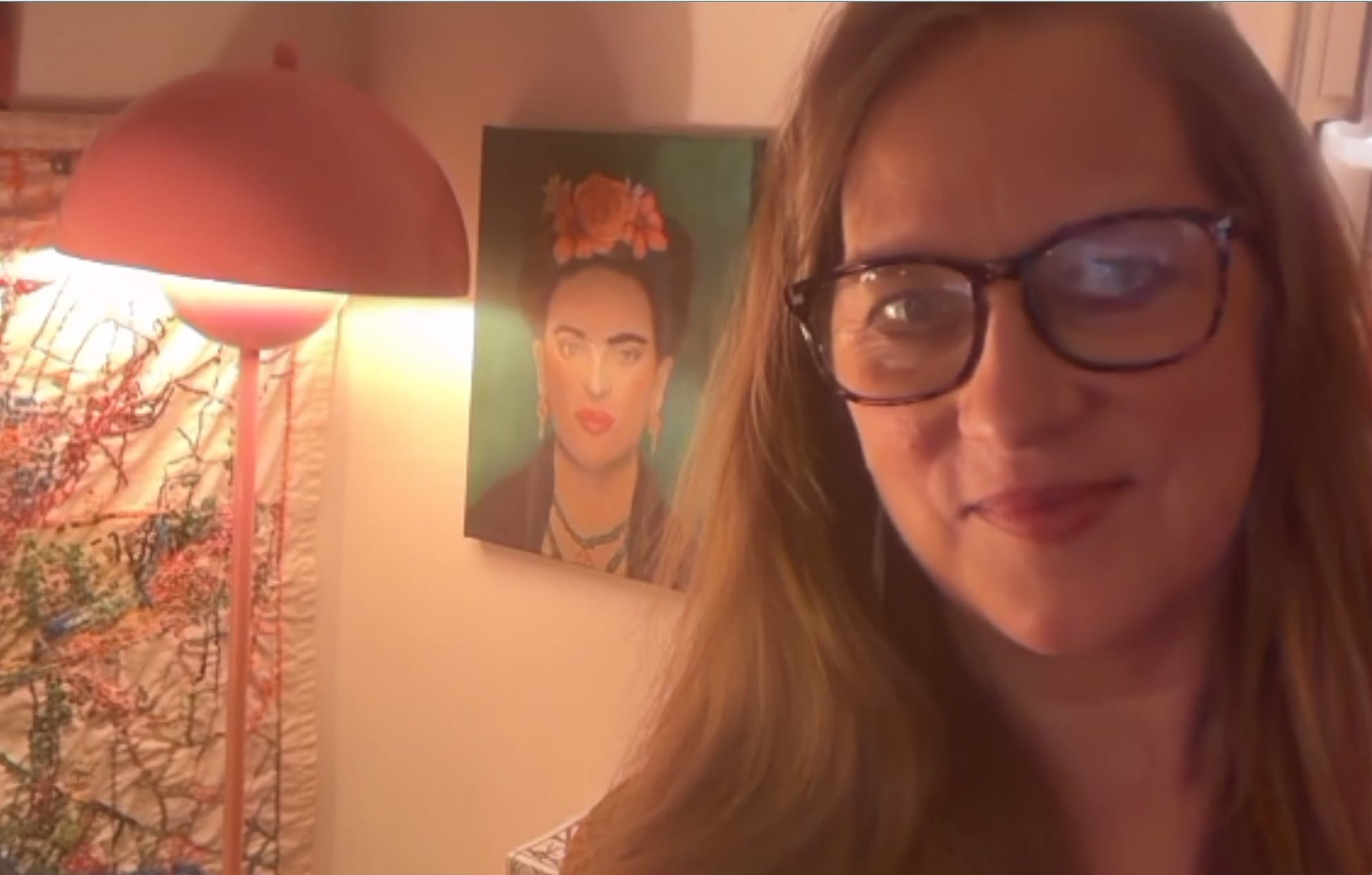
Rebecca Lee is one of my favorite writers and teachers. We met during my MFA at UNC Wilmington, and I could listen to her musings on writing forever. We went deep on her debut novel and spoke about gold standard endings, unrequited love, her current project, and her advice to writers.
I want to start with The City is a Rising Tide. Where did this begin for you?
I have to go so far back in my memory to think about it. I had just moved to North Carolina. That was the one year here that I lived on the ocean, so I was staring out at the ocean when I was writing, which was a total dream for me. I was living on a row of houses at Ocean Isle. The house that I was in eventually fell into the ocean—not when I was in it—but there was a row of houses ahead of mine that were leaning into the ocean, and they looked like creatures leaning in, so I had that setting in my mind.
Also, I was so young then that I still had this dream of living in New York City. I would go to New York in the summers. When I was there, I couldn’t believe that Wilmington existed. It was this beautiful fairyland on the ocean, and it’s so quiet, and you can hear the insect noises at night, and I love the humidity and the sailor feel to living on the beach. When I was in New York, I would dream about being here, and when I was here, I would think that New York City was the most special, glamorous place you could ever be. I think those two settings created that book in a way for me, then there’s also the snowy setting of my childhood.
How I wrote that book was very place based. It was going to be a short story, and she was going to meet up with her old childhood friend at the Seaport in New York City. I was trying to get her to that point, and the story just grew and grew and grew, but it only grew to 100 pages, which is a really weird length. When we tried to sell it, some publishers said, “This is like a novella. Could you write a couple stories and then we’ll publish it, or write a couple more novellas?” Simon & Schuster agreed to publish it as a novel, and I never knew which was the right way to do it. Even before it got published, I met an agent, and he said, “Go work on the book for another year, make it longer, and then I’ll look at it again.” I worked on it really hard for a year, every day for hours a day. I changed almost the entire book, but it remained 100 pages. It couldn’t get any bigger, so I just thought, “That book wants to be that length.”
That question of length is so fascinating—it feels counterintuitive to me. Who wouldn’t want to read a book in a sitting?
I think about that too. Why don’t we love novellas? You’d think culturally we would love them. One of my former professors, Ethan Canin, published a great book of novellas. It’s such a nice way of reading a book. I’ve always wondered why the culture isn’t more interested in short stories, too. Someone explained this to me, and it made sense: as a reader, you’re having to get to know a set of concerns, characters, and settings every time you start another short story, presumably. That takes a lot of starting the engines for the reader, whereas with a novel you have all that heavy lifting at the beginning, and then you can just fall into it.
I know a lot of writers and readers who love starting in media res. They love to be dropped in the middle of a party, and they don’t quite know what’s happening, and they find that interesting. I’m a kind of scared reader at the beginning. I wish every story said, “Cincinnati, 1972” at the top, and then big, long introductions. Wendy Brenner and I talk about this—when I go to a party, I need the host to come to the door and introduce me to everybody carefully and integrate me.


The novel is about unrequited love. What’s rich in that premise for you?
It’s funny. I remember when I was writing that book, I thought, “Who is going to stay with this woman who’s in unrequited love for 100 pages and it never gets resolved?” I often tell students, “If you’re heartbroken, you’ve got to get writing because you’re in a really good place to write right now.” The person doesn’t quite want to hear you as much as you want them to hear you, so you have this sense of needing to speak but there being no place to do it. That’s a really strong engine for writing.
There’s this Emerson line, “True love transcends the unworthy object and dwells and broods on the eternal.” I don’t know if this has to do with youth or what, but there was a desire in me to create a poetic landscape, to let her speak and quote all these poems that had lived in my brain for so long. That was what the project of writing was for me.
On that idea of divinity, everything passes through the prism of Justine’s love. The novel is full of beautiful writing on food, city streets, China, even Peter’s blood sugar. What drew you into writing these lyrical passages on small moments?
I did love writing about food in that book, and I loved thinking about China. I gave myself a lot of freedom, whether I should have or not, but I had lived in Hong Kong for a while, so I was interested in Mandarin.
I had this idea at the time that writing was capturing experience and stopping time. My professor that I talked about to you all the time, Frank Conroy, wrote a memoir called Stop Time, and it stayed with me forever. What you’re doing is capturing moments and not letting them pass by without being noticed. I still think of writing that way, but I’m much more interested now in what happens to people over time. When I was young, I thought of the moment more than the arrow, to use that equation that we sometimes talked about in the MFA.
There was a desire in me to create a poetic landscape, to let her speak and quote all these poems that had lived in my brain for so long. That was what the project of writing was for me.
I had a lot of trouble figuring out Peter at first. I talked to the writer, Bob Reiss, and he said, “You need to interview him alone in a room.” I thought, “I can’t. It’s too silly. I can’t do things like that,” but I did, and it was really useful. Then he said, “Is there something the matter with him that he’s dealing with all the time?” That’s where his cane came from, and he became a diabetic. I won’t go into my own maladies, but I have a problematic left eye that is my canary in a coal mine. Once you know that about someone, you can almost enter their whole life through their problem. Also, my main character was somehow really attracted to that too, and that gave their relationship more gears to work with.
I think the ending of your novel is the gold standard of endings. Do you write towards an ending, or does it arise through your writing?
The ending of that book has been corrupted by hearing too many readers tell me it is not good. It ends all the things that the narrator is trying to think about, so for some readers, it feels like an ending, but others are like, “Well, what happened?” I remember thinking at the time, “You all know what happens when you embezzle money. Let’s talk about the snowy fields of Saskatchewan.” Certain readers say you’re letting yourself off the hook too easily as a writer, and I agree with them too. On the other hand, I can’t imagine that I would have been able to go through a court case and actual things happening at the end of that book without losing the reader.
When you’re reading another writer’s writing, especially if it’s published, you think they have a grasp of what they’re doing. Then you talk to the writer, and they’ll say, “I’m just writing in this miasma of ideas, impressions, hopes, pretensions.” They also don’t know what they’re doing. In a weird way, the reader knows what they’re doing much more than the writer, which is strange.
You mentioned that the novel started as a short story. I’ve heard you say before that the stories of Bobcat started as failed novels. What does that process feel like to you?
The great editor, C. Michael Curtis, said that he loves stories that are compressed novels. I remember hearing that and thinking, “I’d love to write that like that.” When I think of writing the short story, “Bobcat,” at the beginning of that collection, it took forever to write, and I loved every minute of writing. There were a lot of minutes when I hated it too, but I think of that as a pleasure to write. It took years and years, and it’s just a little short story, but I treated the process like you would treat a novel. There’s one paragraph about the Donner party, and I had a whole shelf on my bookshelf about the Donner party, because I thought that was going to be a big part of it. I was trying to research it over a large landscape, but then it kept coming down in the writing to a few little lines. That suited me at the time. Also, I’m not the most ambitious writer in terms of publishing, and that helped me to not feel like I should move faster.
You mentioned Saskatchewan, and it comes up throughout your work. How does the setting of your childhood continue to inspire you?
That’s such a beautiful question. The setting of your childhood is so mixed in with your parents and your life there. I feel like my childhood there was a real bedrock for writing. I think part of it was the era. Reading was the only game in my home. We watched The Mary Tyler Moore Show on Thursdays at seven, but there wasn’t anything else. Reading was really exciting. My mom was a librarian, so she provided me with a lot of books. I swear, this is the way to raise a reader. She’d say, “Put your book down. We’re having dinner now,” or, “Don’t read while you’re brushing your teeth.” It made me feel like I couldn’t wait to get back to my book.
For people who love your work, can you share a bit about what’s exciting to you about your current project?
I’m going to say something, and then I have to explain it. I love the book I’m writing right now, but I have no idea if it’s any good. I think it’s some weird combination of age—I’m turning 59—and there are all these reports that the novel is over and no one’s reading anymore. You can go back to the 1800s and people were saying that there were no more novels. There’s something about the way it’s happening in our moment that I have found liberating. Who knows what’s going to happen to this, so I’m treating it more as a craftsperson. I want to make this beautiful thing that makes sense to me, and I don’t have big ambitions for it beyond that. That’s helping me put things in it that I love.
We’ve talked about this before, Michael, where you give to a work of art for a while, and then sometimes it starts giving you things back. Whatever those things are can be very intangible, but sometimes you just get really interested in it, or you find a passage that you really like and that’s strengthening to your inner life. When you first start writing, it’s not interesting. You’re desperately trying to make it interesting, and then it starts giving back. That started happening with this book, and I feel like the relationship between this book and me is the strongest relationship that I’ve had.
Order The City is a Rising Tide and Bobcat.
Lightning round
Favorite book right now?
Passionate Minds by Claudia Roth Pierpont. Every sentence is so brilliant.
Do you have any current obsessions?
When I was talking about how I feel a new freedom with this novel to write about things I’m actually interested in, there’s a lot of religious ideas in it that I’m thinking about. 10 or 20 years ago, I would have thought, “Nobody wants to hear about the things you cared about in Sunday school when you were 10,” but I’m letting myself think about religious ideas. I got kind of obsessed with the painting, “The Last Supper,” and that made me obsessed with Jesus’ relationship with Judas, because they were such good friends before Judas betrayed him. I don’t mean it in a didactic way, but the story of their lives is interesting to me.
Favorite place in Wilmington?
The pier at the Oceanic.
Best writing advice that you’ve ever received?
This is a really important piece of advice. I say this from my age vantage point, and I wouldn’t have known it when I was younger, but write it now. The things you can write about now, you will not be able to write about a year from now, or five years from now, or 10 years from now. In some ways, I’m a much more powerful writer now than I ever was, but there are certain things I wrote in my youth that I could never write now. There’s a kind of engagement with the language that I couldn’t achieve. There isn’t a future time where you’re a better writer. There’s what you can do now, and keep capitalizing on what you can do now.
Reference Section
I’m editing the books section at the Portland Press Herald! This week, I spoke with Anna Fitzgerald Healy about her debut, Etiquette for Lovers and Killers. Kaylie Saidin spoke with larissa pham about Discipline, and Lisa Hiton talked with Brock Clarke about his latest story collection, Special Election. I’d love it if you gave these a read and support Maine books and local newspapers!
Note: I earn a small commission when you shop for books through my Bookshop links, and I appreciate your support, which helps keep Referential free.