
Why do we need third places?
What I filed with my editor at The Boston Globe

When I got a call for pitches and an assignment for a first-person essay about Maine’s saunas for Boston Globe Magazine, I was quick to say yes. This was one of those no-brainer assignments—I knew who I wanted to talk to, and the essay wrote itself while I was at yoga one day (oops!)
After filing, the issue pivoted the package to a service approach, and the story ran in a different form. To pull back the curtain on process, I’m excited to share what I originally filed with my editor here.
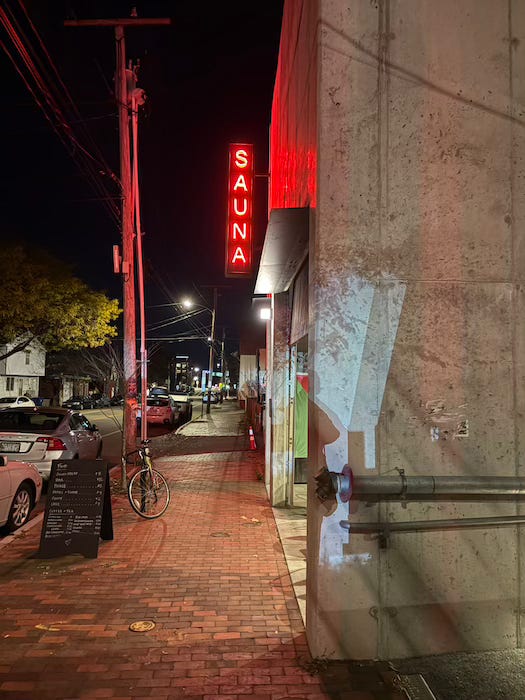
About half a mile down Portland’s Washington Avenue, past the brewery, the Southwestern barbeque joint, the gin distillery, the Japanese izakaya, the kombucha distillery, and fermented foods store, weekend adventurers will find a modernist concrete box with a millennial neon red sign reading, SAUNA.
Built on an empty lot in 2021, the Washington Baths were intended to arise through the hip hubbub of rapidly developing East Bayside as an urban oasis.
“We wanted the place to be less of a retreat experience and more of something that people could integrate into their everyday lives,” said Asher Woodworth, the sauna’s founder and co-owner.
Comprised of two gender-segregated saunas, a courtyard cold plunge and hot tub, and a relaxation room outfitted with lounge chairs and music befitting Eyes Wide Shut, the Washington Baths crops up as a wintertime relaxation hub, a place to get out of the house during colder months in a city known primarily for its food.
I was living in North Carolina when the baths opened. Prior to my first visit, my exposure to sauna culture was limited to chickening out of the sauna’s heat at Japanese onsen and slinking inside the Russian & Turkish Baths in New York, where on a Sunday morning, your attention could be pulled between coquettish gay men and Eastern Europeans being beaten by grape leaves by equally stern attendants.
I couldn’t have anticipated the Baths’ scene. The aesthetics are immediately striking, brutalist. Woodworth designed the Baths with friend and architect Kiel Moe, who at the time was working at the Harvard Graduate School of Design and specializes in thermodynamics and modern architecture. “We started thinking about the building like a thermodynamic system,” Woodworth said. The modernist, concrete design is thus both functional and aesthetic. Aspiring for a “human scale, warm modernism,” they drew inspiration from early British “New Brutalism” and the work of Alvar Aalto, Tadao Ando, and Luis Barragán.
Inside the sauna, I was surrounded by nude Gen Z and Gen X men, regulars who knew each other from their days spent sweating in tandem, who wore rubber sauna watches and spritzed water from plastic bottles into their mouths when the steam began to hiss. The air was congenial, friendly. They were as comfortable as Tony Soprano schvitzing with his gang. After watching a man perform calisthenic exercises in the courtyard, I googled notable iceman Wim Hof when I returned home.

In Maine, where winters can drag, saunas present an opportunity to derive some peace from the frigidity. Across the city, Good Medicine Collective hosts a private sauna suite, which groups can reserve to cycle through the heat and cold plunge. The Longfellow Hotel, a wellness property built around the concept of promoting a good night’s sleep, features a posh private infrared sauna suite and cold rain shower.
True sauna devotees could make a tour across the state. In inland Denmark, Nurture Through Nature retreat center and campground is home to a wood-fired sauna where bathers bolt into a nearby creek to plunge. Oyster farm Glidden Point in Edgecomb invites guests to nosh on the local crop after their session. To plunge in the wild, “Scandi-inspired” Sea Sauna in Kennebunkport floats on a dock on the mouth of the Kennebunk River, and Cedar Grove operates mobile saltwater saunas.
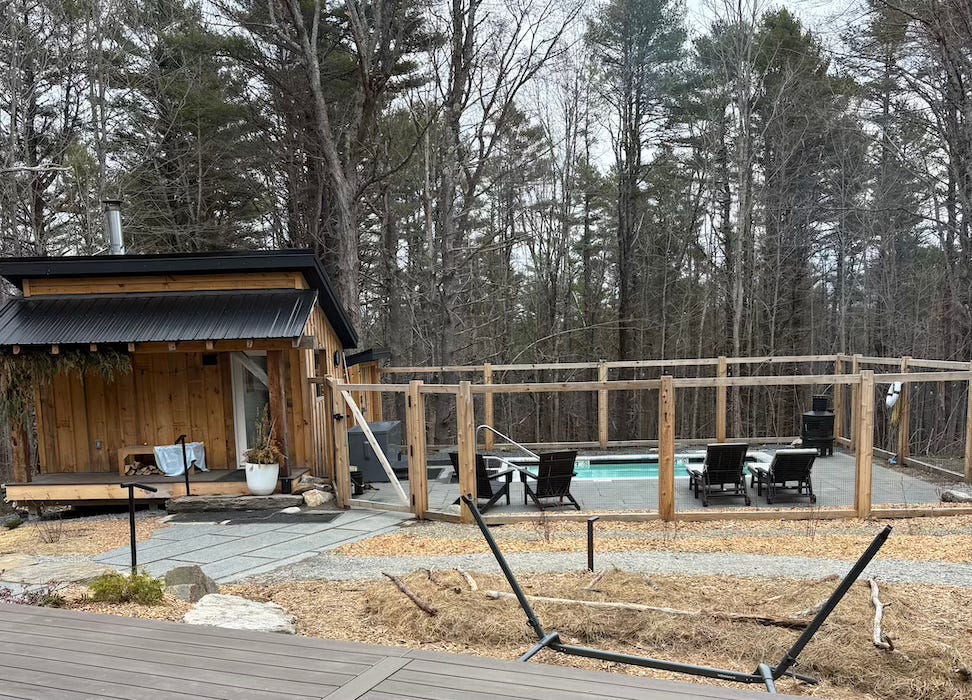
“The culture around Nordic spas in general is active recovery,” said Ashley Baldwin, co-owner of Waterstruck Wellness in the woods of Newcastle. Many guests stop in after ice skating, cross-country skiing, or on their way home from Sugarloaf. Baldwin and her husband visited saunas in Quebec, where the Nordic spa experience has become popular with hotspots like Strøm and Bota Bota. Through their research, they appreciated how these spas integrate wellness practices into nature.
They saw saunas complement how Mainers spend their winter days. Prior to opening Waterstruck, Baldwin and her husband invited friends to their home sauna for potlucks.
“It allowed people that probably wouldn’t interact otherwise to come together in an intimate way, especially in the wintertime,” she said. “It’s tough to find third places in the community that aren’t bars or the YMCA, or spaces that are centered around wellness in this way.”
The sauna becomes something of a “third place,” a public spot for people to gather outside the home. If you don’t want to dine out or sit at a bar, the sauna provides a compelling alternative, where sweat, breath, and cold air ask you to sit with friends and strangers as the energy shifts.
Woodworth was motivated by a similar imperative. Inspired by the same Russian & Turkish Baths and Helsinki’s public sauna culture, Woodworth envisioned a place where people could meet for an hour or two after work or before going out. “It could be part of a more urban experience.”
They figured this into the building’s design—beyond thermodynamics, the Washington Baths’ concrete walls provide another insulating function. The sauna sits on a busy road. On a winter night, you can slip into the hot tub outdoors, gaze up at the stars, and melt into the night air, in the heart of the city.
A different version of this story appeared in The Boston Globe Magazine on November 20, 2025. Read it here.
Reference Section
In this spirit of third places, I have a new story out in Organic Spa Magazine about the evolution of urban wellness. This was such a fun one to report.